Global buyers need more than a generous warranty headline. They need clear coverage, measurable limits, and a practical claims process. This guide examines What warranty terms are reasonable for aluminum door products across residential, commercial, and coastal projects. It focuses on frames, finishes, hardware, seals, glass, installation, and replacement responsibilities.
David H. Baker, an independent fenestration warranty consultant with more than two decades of project experience, states, “A reasonable warranty protects the buyer from manufacturing defects without promising performance that installation cannot control.” That distinction matters. A five-year hardware warranty may be adequate for a private home, but busy hotels may require stronger cycle testing and faster replacement support. A ten-year frame warranty sounds impressive. Yet it means little without corrosion limits, finish definitions, and approved installation conditions.
Details decide trust.
This 2026 overview compares common warranty periods, exclusions, regional expectations, and supplier obligations. It also considers salt air, ultraviolet exposure, temperature changes, packaging damage, and delayed construction schedules. These conditions can reveal weaknesses that factory testing misses. Buyers should request written remedies, response times, inspection procedures, and freight responsibilities before signing purchase agreements. Warranties should also explain whether labor, removal, refitting, and local service are included.
No warranty is perfect.
Some terms may appear reasonable but remain difficult to enforce across borders. That is an uncomfortable limitation. Reliable suppliers acknowledge it, document assumptions, and provide evidence from completed projects. The strongest warranty is not always the longest. It is the clearest, fairest, and most usable when a door fails at the worst possible moment.
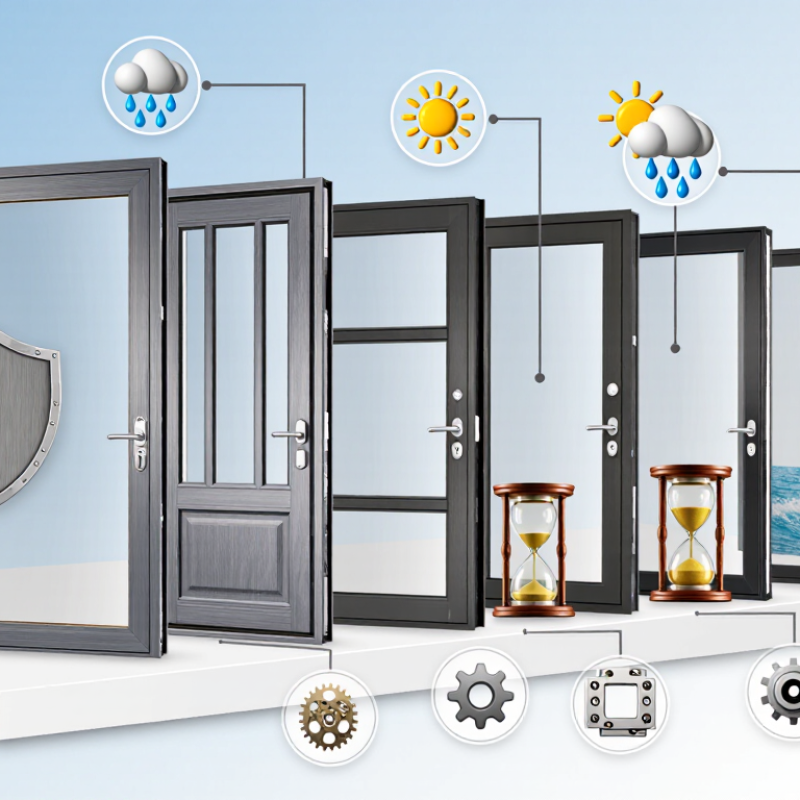
For 2026 global buyers, an aluminum door warranty should define each covered component clearly. The frame section should identify profiles, corner joints, welds, and drainage paths. Coverage may address corrosion, deformation, and manufacturing defects under normal installation. Ask whether the warranty covers the complete frame or only replacement profiles. A site inspection often reveals the difference. Record photos of corners, sill channels, and powder-coated surfaces before installation. Keep delivery records and installer reports with the project file. These details make a claim easier to verify.
Hardware terms need equal precision. Hinges, locks, rollers, handles, and closers should have separate coverage periods. The document should explain failures caused by adjustment, misuse, salt air, or missing maintenance. Glass coverage should distinguish seal failure, visible cracks, scratches, and accidental impact. It should also state measurement tolerances and replacement responsibilities. Finishes require practical wording. Specify color variation, fading, chalking, and coating loss after exposure to sunlight or coastal moisture. A finish warranty can sound strong while excluding the elevations buyers care about most. That weakness deserves direct questioning. In my experience, unclear exclusions create more disputes than short warranty periods. The wording may never be perfect, but every assumption should be written before purchase.
Typical stated warranty periods used in international aluminum door contracts. Coverage depends on the supplier, destination market, installation conditions, and written warranty terms.
Frames commonly receive the longest coverage because they are durable structural components. Hardware, glass, and finishes generally have shorter or condition-based coverage, especially where corrosion, improper installation, chemical exposure, or normal wear is excluded.
For global buyers, the headline warranty is only half the decision. A typical aluminum door offers a 5–10-year frame warranty, while locks, rollers, closers, and hinges receive only 1–5 years. The difference matters. Hardware moves daily, faces moisture, and often fails before the frame. Ask whether coverage includes replacement parts, labor, corrosion, finish fading, and shipping. Many terms exclude damage caused by salt air, poor drainage, incorrect cleaning, or unapproved installation.
The International Aluminium Institute’s 2024 material-flow data places building and construction at roughly one-quarter of global aluminum demand. That scale makes durability commercially important, not merely cosmetic. The 2024 Global Status Report for Buildings and Construction reports that buildings consume about 32% of global energy and produce around 34% of energy-related emissions. Longer service life can reduce replacement waste, although a warranty alone cannot prove performance.
Read the exclusions carefully.
A practical comparison should record the frame period, hardware period, start date, claim procedure, and transfer rules. Some warranties begin at shipment, not installation. That detail can remove months of protection. Field inspections also show a common weakness: buyers compare ten-year frame coverage but ignore a two-year roller warranty. Coastal projects need written corrosion language. High-traffic entrances need cycle testing and locally available parts. ASTM and FGIA testing can support product evaluation, but test results do not automatically extend warranty coverage. A longer promise sounds better, yet weak installation records can still leave the buyer exposed.
2026 Top Aluminum Door Warranty Terms for Global Buyers
A strong finish warranty should connect field experience with measurable testing. AAMA 611 evaluates anodized architectural aluminum, including coating quality, sealing, color consistency, and surface performance. Ask for the coating class, inspection method, covered exposure zone, and remedy for defects. “Ten-year finish warranty” sounds reassuring. It is incomplete.
ISO 9227 defines neutral salt spray procedures, but it does not predict exact outdoor service years. It also does not set one universal pass or fail limit. Therefore, a supplier should state the test duration, specimen preparation, corrosion rating, and acceptance threshold. A door tested for 1,000 hours is not automatically protected for ten coastal years. Site conditions change everything. Salt deposits gather around hinges, drainage slots, and lower frame corners.
The International Aluminium Institute reports annual global primary aluminium production above 70 million tonnes, showing the scale of this supply chain. Yet volume does not guarantee finish reliability. I would request independent laboratory reports, batch traceability, and photographs after testing. Check whether corrosion appears at cut edges or only on flat panels. That detail matters. One practical weakness remains: many warranty documents describe color change vaguely. Buyers should demand measurable limits, maintenance duties, exclusions, and a written process for inspection claims.
For global buyers, an aluminum door warranty should state its EN 12207 air-tightness class clearly. The standard ranks air permeability from Class 1 to Class 4. Class 4 provides the tightest performance under tested pressure. However, a higher class does not automatically guarantee comfort in every building.
Ask for the complete test report, not only a sales statement. It should identify the door size, configuration, seals, hardware, and testing pressure. A laboratory result for one small sample may not represent a large sliding door.
Test it twice.
Installation quality matters. Uneven frames, damaged gaskets, or poor drainage can reduce actual performance.
Warranty terms should explain whether the Class 1–4 claim covers the complete installed door or only factory components. They should define inspection procedures, repair timelines, seal replacement, and exclusions for incorrect installation or later building movement. In practical project reviews, these details often prevent disputes.
Yet even a precise warranty can miss site conditions. Buyers should record delivery damage, installation alignment, and commissioning results with photographs. A stronger claim is useful, but field evidence remains essential.
2026 Top Aluminum Door Warranty Terms for Global Buyers
Assess Global Claims, Installation Duties, Exclusions, and Transfer Terms
A useful aluminum door warranty must explain claims across borders. Buyers should check the claim deadline, required documents, and response channel. Keep the invoice, product code, delivery record, and installation photos. These details can prevent avoidable disputes. Some suppliers request samples or inspection reports before approving replacement parts. Shipping damage should be reported quickly, ideally within 48 hours. A practical warranty also states who pays return freight, customs charges, and local service costs.
Installation duties deserve equal attention. The warranty may require trained installers, approved fasteners, correct drainage, and plumb frames. Poor alignment can create rubbing, water leakage, or failed locks. Normal coastal corrosion, harsh chemicals, misuse, and unauthorized modifications may be excluded. However, vague wording creates uncertainty. Buyers should request measurable limits for wind exposure, finish performance, and hardware durability. Local climate conditions matter. A door installed near saltwater needs different maintenance than one used indoors.
Tips: Ask for a claim checklist before ordering. Photograph every carton before opening it. Record frame levels and clearance gaps during installation. Confirm whether coverage follows the original buyer or the property. Transfer terms may require written notice, fees, or proof of ownership. Some warranties end after resale. That feels restrictive, but it is common. Still, buyers should negotiate transferable coverage for commercial projects. Review the final warranty against the quotation, because small differences often matter.
| Market or Legal Environment | Typical Written Warranty Structure | Claim Period or Legal Protection | Installation Duties for the Buyer | Common Exclusions | Transfer and Ownership Terms | Recommended Claim Evidence |
|---|---|---|---|---|---|---|
| European Union consumer sales | Commercial warranties commonly cover manufacturing defects in frames, panels, hardware, seals, and finishes for separately stated periods. | Consumer goods generally have a minimum two-year legal guarantee under EU consumer-sale rules, subject to national implementation and contract details. A commercial warranty may provide longer coverage. | Installation must follow the supplied instructions, applicable building rules, and approved drainage, fixing, alignment, and sealing methods. Some warranties require qualified installation. | Improper installation, unauthorized modifications, misuse, inadequate drainage, abnormal moisture, impact, chemical damage, normal wear, and failure to maintain moving parts. | Legal consumer rights generally remain connected to the original consumer transaction. Commercial warranty transfer usually requires written approval or proof that the product remains at the original address. | Invoice, delivery record, installation date, photographs, serial or batch information, installer details, and evidence of compliance with maintenance instructions. |
| United Kingdom | Written warranties commonly separate periods for powder coating, insulated glass, hardware, seals, and installation workmanship. | Consumer contracts are subject to statutory rights under the Consumer Rights Act 2015. Limitation periods can be up to six years in England and Wales and five years in Scotland, but this is not the same as a six-year product warranty. | The buyer should use competent installation, comply with British standards and building regulations where applicable, maintain drainage paths, and avoid forcing or misaligning the door. | Poor surveying, incorrect threshold support, condensation caused by building conditions, accidental damage, abrasive cleaning, corrosion from harsh environments, and unauthorized repairs. | Assignment is normally governed by the written warranty. A resale may preserve statutory rights against the seller only in limited circumstances and should not be assumed to transfer a manufacturer warranty. | Proof of purchase, survey measurements, installation certificate, maintenance log, photographs, and written notice of the defect within a reasonable time. |
| United States | Limited warranties often distinguish product components from labor. Coverage may be longer for aluminum frames and finishes than for hardware, weather seals, screens, or installation. | There is no single nationwide warranty period for aluminum doors. Written terms, state law, the Uniform Commercial Code, and consumer-protection rules may apply. A written warranty should state duration and remedy clearly. | Follow the installation manual, local building codes, flashing and water-management requirements, rough-opening tolerances, and product-specific fastener instructions. | Labor not expressly included, water intrusion caused by surrounding construction, coastal or industrial exposure beyond the stated rating, glass breakage, normal color change, misuse, and alterations. | Many commercial warranties are limited to the original purchaser or original installation address. Transfer, if allowed, commonly requires registration, notice, and payment of an administration fee. | Purchase invoice, product identification, installer invoice, photographs of the defect and surrounding construction, climate or exposure information, and maintenance records. |
| Canada | Written coverage commonly separates frame integrity, finish performance, insulated glass, hardware, weather seals, and installation labor. | Warranty periods vary by contract and province. Provincial consumer-protection and sale-of-goods rules may provide additional implied protections, while commercial buyers may have fewer consumer-law remedies. | Installation should account for local climate, freeze-thaw movement, vapor control, drainage, sill support, and applicable Canadian building requirements. | Freeze damage from blocked drainage, condensation related to indoor humidity, salt exposure beyond stated limits, impact, poor maintenance, and installation outside specified tolerances. | Transfer rules are contract-specific. Coverage may be restricted to the original purchaser or may continue for a subsequent owner if the door remains installed at the original property. | Invoice, property address, installation date, climate exposure, proof of proper winter maintenance, photographs, and details of any remedial work. |
| Australia | Commercial warranties typically cover defects in materials and workmanship, with separate provisions for finish, hardware, glass, seals, and labor. | Australian Consumer Law provides consumer guarantees that goods be of acceptable quality, fit for purpose, and match their description. These guarantees do not have one fixed warranty duration and depend partly on the expected life of the goods. | Installation should comply with the manufacturer’s instructions, the National Construction Code, relevant Australian standards, coastal-environment requirements, and correct water-shedding practices. | Failure to wash down salt deposits, incorrect sealants, poor flashing, building movement, impact, unauthorized alterations, harsh chemicals, and damage from cyclones or extreme events outside the rating. | Consumer guarantees attach to the consumer transaction and circumstances of supply. A separate commercial warranty may restrict transfer, so resale terms should be confirmed in writing. | Tax invoice, installation records, product configuration, coastal exposure details, cleaning records, photographs, and evidence that the door was used for its intended purpose. |
| New Zealand | Written warranties commonly define component coverage and may provide a separate workmanship period for installation performed by an approved installer. | The Consumer Guarantees Act may apply to consumer purchases and requires goods to be acceptable quality and fit for purpose. The statutory remedy is not automatically limited to the written warranty period. | Use correct sill support, head flashing, drainage, sealants, fixings, and tolerances. Installation must meet applicable building requirements and the product instructions. | Poor maintenance, blocked drainage, incorrect cleaning products, building movement, accidental damage, exposure beyond the design environment, and non-approved modifications. | Written warranty transfer is usually subject to its own conditions. Retaining the original invoice and installation information is important when a property changes ownership. | Proof of purchase, installation and maintenance records, photographs, property details, and a description of the operating conditions. |
| Middle East and Gulf markets | Project warranties often specify a defined defects-liability period, with longer optional coverage for aluminum profiles or finishes and shorter coverage for consumable components. | The contract, tender documents, local commercial law, and project specifications usually control. Warranty duration should be stated by calendar period and commencement event. | Protect products from cement dust, welding sparks, sand, extreme heat, and prolonged storage exposure. Installation should include correct anchors, thermal movement allowances, sealants, and drainage. | Sand abrasion, salt-laden air, aggressive cleaning chemicals, construction damage, thermal distortion caused by dark finishes or reflective surroundings, and unsuitable sealants. | Project warranties are commonly tied to the named purchaser, project, or original installation. Transfer to a building owner or facilities operator should be expressly documented. | Contract, approved submittals, delivery inspection, installation inspection, site photographs, environmental exposure data, and commissioning records. |
| East and Southeast Asia | Export warranties commonly cover manufacturing defects for a stated period from shipment, delivery, or installation, with separate exclusions for local installation and site conditions. | The governing law, export contract, purchase order, and destination-country consumer or commercial rules determine the remedy. International buyers should not rely on an unstated standard warranty period. | The importer or local contractor should verify dimensions, storage conditions, hardware compatibility, drainage, sealant compatibility, and compliance with destination-country codes before installation. | Transit damage not recorded at delivery, incorrect local installation, incompatible hardware, humid or marine exposure, unauthorized replacement parts, and failure to protect products during construction. | Export warranties often remain with the original buyer and destination project. Assignment normally requires written consent and may exclude labor, removal, reinstallation, duties, and freight. | Commercial invoice, packing list, bill of lading, delivery inspection, damage report, installation records, product photographs, and correspondence showing the claim date. |
| International commercial projects | The strongest contracts identify each covered component, the start date, remedy hierarchy, labor responsibility, shipping responsibility, and maximum liability. | The written contract should specify governing law, dispute forum, claim notice deadline, inspection rights, and whether the warranty period is suspended during repair or replacement. | Buyer duties should include approved storage, inspection on arrival, qualified installation, compliance with drawings, commissioning, routine maintenance, and prompt defect notification. | Consequential loss, business interruption, removal and reinstallation costs, misuse, force majeure, design errors by others, site movement, incompatible interfaces, and unapproved repairs. | Require an assignment clause covering sale of the property, replacement of the buyer, facilities-management changes, and project financing. State whether transfer extends or shortens the remaining term. | Maintain a complete warranty file containing contract documents, approved drawings, batch records, delivery inspections, installation certificates, maintenance logs, photographs, and claim correspondence. |
It should identify frames, corner joints, welds, drainage paths, hardware, glass, and finishes. A complete frame claim is stronger than a profile-only replacement. Check this carefully.
Ask about corrosion, deformation, defective welds, damaged joints, and blocked drainage channels. Photograph sill channels and corners before installation. Small records can prevent large arguments.
Hinges, locks, rollers, handles, and closers should have separate coverage periods. The warranty should explain failures caused by adjustment, misuse, salt air, or poor maintenance. Some wording may remain unclear.
The document should distinguish seal failure, visible cracks, scratches, and accidental impact. It should also state measurement tolerances and replacement responsibilities. Glass claims are rarely simple.
It should address color variation, fading, chalking, and coating loss. Ask how sunlight and coastal moisture affect covered surfaces. A ten-year promise means little without measurable limits.
No. Salt-spray testing compares resistance under controlled conditions. It does not guarantee a specific number of outdoor years. Request test duration, specimen preparation, corrosion rating, and acceptance limits.
Keep delivery records, installer reports, alignment checks, and commissioning photographs. Record corners, hinge areas, drainage slots, and coated surfaces. Evidence matters.
The classes describe tested air permeability. Class 4 indicates the tightest tested performance. It does not guarantee comfort in every building. Site conditions still interfere.
The report should identify door size, configuration, seals, hardware, and test pressure. A small laboratory sample may not represent a large sliding door. That assumption deserves another review.
Uneven frames, damaged gaskets, poor drainage, and later building movement can reduce performance. Ask whether coverage applies to the installed door or factory components only. The wording may never be perfect.
For global buyers, reasonable aluminum door warranty terms should clearly define coverage for frames, hardware, glass, seals, and surface finishes. A practical structure is a 5–10-year warranty for door frames, supported by a 1–5-year period for hardware and moving components, while glass and seals should have separate terms based on their expected service life. Finish guarantees should identify resistance to fading, peeling, and corrosion, with testing references such as AAMA 611 and ISO 9227 where applicable. Performance statements should also be verified through documented EN 12207 air-tightness classifications, typically ranging from Class 1 to Class 4.
The key question is: What warranty terms are reasonable for aluminum door products? Buyers should review claim procedures, evidence requirements, installation responsibilities, maintenance duties, geographic coverage, exclusions, and whether the warranty can be transferred to a new property owner. Clear language on improper installation, unauthorized modifications, extreme conditions, and normal wear helps prevent disputes and ensures that warranty protection matches actual project needs.

Magella Door